


EPRTNT and PADAT: Structuring a Single Business Plan
A methodology for structuring a combined EPRTNT and PADAT business plan for tourism accommodation in Québec. Non-cumulation, coordination, expertise and institutional sources.
ARTICLE
Emilie Penazzi
5/18/2026
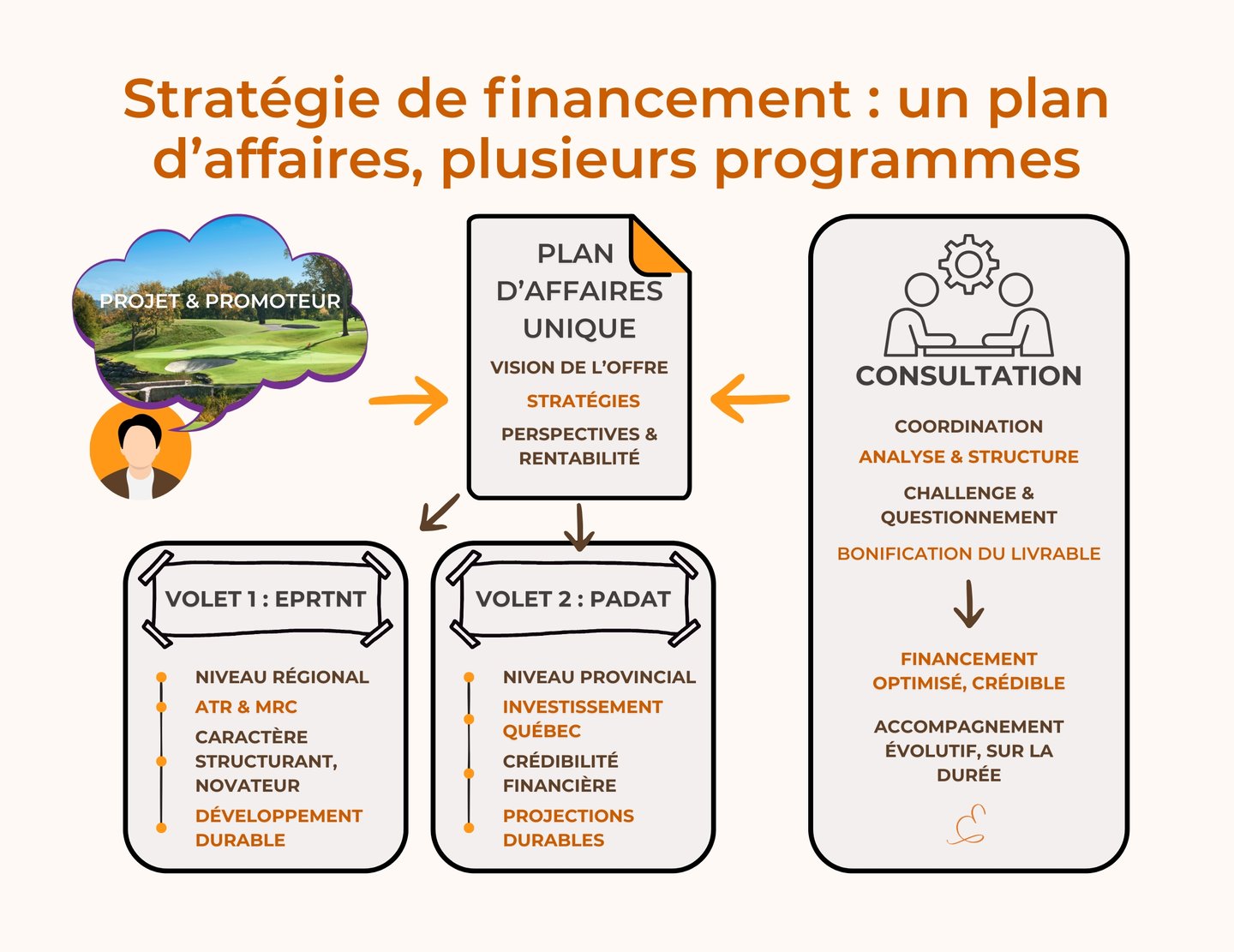
In May 2026, as part of a mandate for a golf club in Lanaudière, I submitted a business plan structured across multiple funding programs. Following a project qualification analysis, I deliberately designed the document to simultaneously meet the criteria of two distinct institutional programs: the EPRTNT 2025-2027, coordinated with Tourisme Lanaudière, and the PADAT, administered by Investissement Québec.
What this experience taught me about structuring such an application, the questions to ask upfront, and the rules that determine its strength, I'm sharing here. By unpacking this experience, I want to offer a practical reference point for project owners wondering whether their project is well positioned for a similar institutional funding application, and where to start.
Tourism funding for hotel projects in Quebec draws on several complementary programs
Tourism is one of the most heavily supported sectors in Quebec's economic policy, and for good reason: it accounts for close to 5% of the province's GDP, supports more than 420,000 jobs, and generated record revenues of nearly $19 billion in 2025, according to data from the Ministry of Tourism. For developers building or renovating a tourism accommodation property in a regional market, this environment translates into an ecosystem of institutional funding programs that needs to be understood, combined, and activated at the right time.
The two flagship programs for accommodation are the Entente de partenariat régional et de transformation numérique en tourisme (EPRTNT 2025-2027) and the Programme d'appui au développement des attraits touristiques (PADAT), administered by Investissement Québec on behalf of the Ministry of Tourism. The PADAT was relaunched in July 2023 with an envelope of $180 million over three years, or $60 million per year in the form of loans and loan guarantees. On top of that, the 2026-2027 budget added an additional $26 million over three years to strengthen the program. That is a clear signal of the government's commitment to private investment in tourism hospitality, at least through 2029-2030.
The EPRTNT 2025-2027, for its part, offers a non-repayable contribution of up to 50% of eligible costs for structuring tourism accommodation projects, with a maximum contribution that varies by region (up to $150,000 under the Accommodation stream in Lanaudière, for example). It is managed by regional tourism associations (ATRs), which serve as the entry point and issue sector-level recommendations. These two mechanisms do not fund the same things, do not address the same needs, and are not managed by the same teams. That gap creates a strategic opportunity for developers who know how to read it.
Three vulnerabilities to anticipate in a multi-program application
The first mistake is treating both programs as variations of the same exercise. A developer who submits the same business plan to both funding bodies with nothing more than a cover page swap will run into fundamentally different evaluation criteria. The EPRTNT assesses the project's structural significance for the region, its alignment with the ATR's priorities, its innovative character, and its grounding in sustainable development principles. Investissement Québec, for the PADAT, focuses primarily on the developer's financial soundness, profitability outlook, the coherence of the financing structure, and the quality of financial projections. These are not the same angles, and what convinces one reviewer will not necessarily convince the other.
The second mistake is allowing qualitative assumptions and financial projections to develop independently. In an institutional funding application coordinated across two distinct areas of expertise (a CPA firm for the financial structure, a specialized firm for the market study), the risk of internal inconsistency is real. A market study projecting 65% occupancy in peak season, paired with financial projections built on 55%, produces a document that contradicts itself. This type of inconsistency is among the first things an institutional review committee will catch, and it undermines the entire funding application.
The third mistake is failing to plan for the rules governing the stacking of government grants. The Ministry of Tourism's programs set precise limits on what expenses eligible for a non-repayable contribution can or cannot also receive through cross-funding. Overlooking these rules at the outset forces costly restructuring of the application mid-process, sometimes at the worst possible moment.
A four-step approach to structuring an EPRTNT and PADAT hotel business plan
Step 1: Map the project components before writing anything
The first requirement for a solid multi-program application is structural: every component of the project must be identified, characterized, and matched to the most appropriate program before drafting begins. From this mapping comes the most important strategic decision in the entire process. How a project is broken down into its components determines the architecture of the whole application and, ultimately, its level of exposure to the risk of rejection. This is where a consultant plays a genuine strategic advisory role.
Step 2: Ground the business plan in a vision for the offer, not just numbersA strong business plan is, above all, a document that makes a case for a vision: why this project, in this region, for which clientele, with what positioning. That vision is what gives the financial projections their credibility, because it explains the pricing assumptions, the seasonal model, and the operational choices. Without this narrative backbone, the numbers remain too abstract.
The EPRTNT is particularly attentive to this dimension: the innovative character and quality of the concept are among the program's official selection criteria. The PADAT, for its part, expects a clearly articulated marketing strategy tied to the target markets, and requires a demonstration of profitability potential. Both demands point to the same underlying need: a credible, documented, and defensible vision for the offer.
Step 3: Keep stakeholder alignment continuous, not episodic
In multi-stakeholder projects (CPA firm, market research firm, project owner), coordination needs to be ongoing. The market study assumptions feed directly into the financial projections, which in turn need to reflect the operational choices laid out in the plan. A cross-validation process with the consultant present at each stage prevents the internal inconsistencies that can unravel an otherwise strong application in front of a review committee.
Step 4: Document the path of every dollar spent
Both programs require rigorous and specific documentation of eligible costs, and the requirements are not identical from one program to the next, nor from one region to another for the EPRTNT. Traceability for each line item, its explicit link to the relevant program, and the coherence between documents produced by each stakeholder are the baseline requirements for a defensible application. This is also the phase where coordination errors between the CPA firm, the market research firm, and the project owner are most likely to surface.
The non-stacking rule: the most common blind spot in hotel grant applications
The principle governing the non-stacking of government grants is the most essential, and yet the most frequently misunderstood, rule in multi-program applications. This likely reflects the fact that each program has its own dedicated point of contact, which is precisely why a consultant's role is to bridge between them. In practical terms, the rule is straightforward: a single invoice cannot be submitted for reimbursement under more than one funding program.
Client experience and regenerative tourism as credibility levers
The EPRTNT explicitly evaluates the quality of the concept, products and services, consideration for sustainable development principles, and the innovative character of the submitted project. These criteria need to run consistently through the entire document.
A project grounded in regenerative tourism principles, including territorial value, immersion in the destination's identity, and the creation of positive community outcomes, directly addresses these evaluation criteria. But this positioning needs to be operationalized throughout the plan, not just written as marketing language on a brochure.
For which developers and in which contexts this approach applies
The approach described here is relevant for any developer building or rehabilitating a tourism accommodation project in a Quebec region where the EPRTNT ecosystem is active, and whose investment level justifies pursuing both grant funding and an institutional loan. It is particularly well suited to projects that combine an attraction component (a feature, an activity, a facility) with an accommodation component, because this combination naturally touches multiple EPRTNT streams and multiple PADAT criteria at the same time. Each program, of course, remains accessible independently, and a project may qualify for one without qualifying for the other.
It is less suited to early-stage projects with no financial track record (the PADAT requires three years of financial statements), to projects located on the island of Montreal or in Quebec City under the PADAT's construction component (both are explicitly excluded), and to projects where accommodation is secondary to a primary activity such as food service or retail.
In the end, the role of a hotel development consultant on this type of file goes well beyond writing. It means acting as an integration strategist: coordinating preliminary verifications, reading the data produced by each expert, aligning it into a coherent whole, identifying blind spots, and building an overarching vision, strengthened by one's own field expertise, that turns a list of components into an offer that can genuinely hold up in front of an institutional review committee.
The right questions to ask before submitting a funding application
Avant de structurer un dossier, quelques questions préalables peuvent vous permettre de vous situer dans l'état d'avancement de votre projet.
Is your equity contribution in place? Both programs require a minimum private contribution, which varies by stream and applicant profile. This is a foundational condition, one to confirm before anything else.
Is your project sufficiently developed? An institutional business plan documents a defined project, not a concept still in development.
Are the regulatory prerequisites covered? Zoning, permits, and related approvals: some are explicit eligibility conditions, others directly affect the credibility of the application before a review committee.
Is your offer structure clearly defined? Without this articulation, the application is not ready to be built.
These questions do not always have straightforward answers, and that is precisely where advisory support earns its value.
To read the project profile related to this article, click HERE.
With Emilie, Bonjour!, my work consists of supporting and structuring these projects through to completion. You have a vision and want to talk about it? Contact me for a free initial meeting.